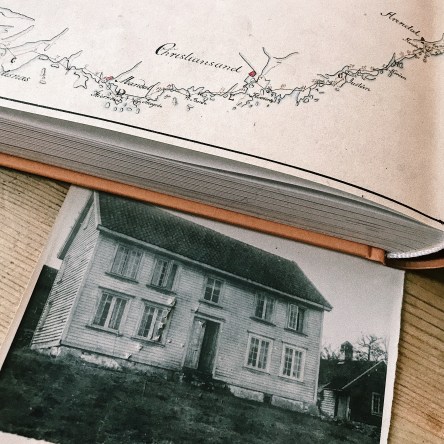
Places trigger memories for insiders, who have shared a common past, and at the same time places often can represent shared pasts to outsiders who might be interested in knowing about them in the present
Winter and Sivan, 2000
In this post I am mainly going to focus on the history of previous generations, the reason for this is that my father´s main focus is from my father grandparents and generation before them. The last generation did not have farm animals on the farm nor was it a working farm. it is also important to mention that since then we are establishing my father’s memories and feelings, this ultimately is my fathers side of the family. The quote above represents a big part of this site, my father shared memories and history connect him to those before him due to the place he lives and grew up.
My father’s grandparents:
As mentioned in the previous post, I talk about the production on the farm. My father’s grandparents were the last generation before my father’s generation who produced food and kept animals on the farms. My father remembers my grandparents while they lived in the house, he remembers specific details (that are included in the interview) This was before the renovation took place in the house and this is important because my grandparents kept all the old furniture in the house and they kept the old silhouette which later when the house was renovated made my father think of the importance of the history of where he came from.
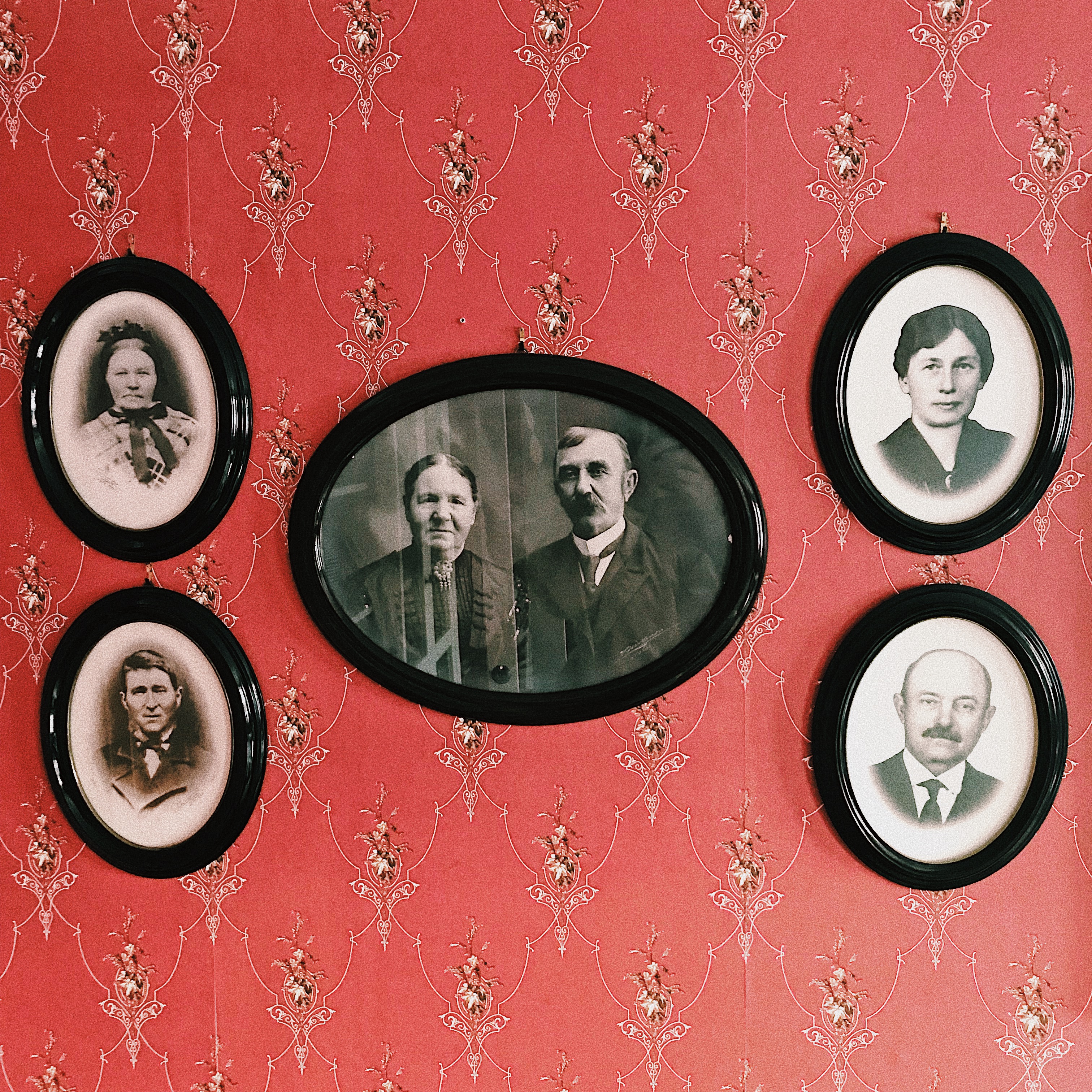
in the middle: Johan Severin Nilsen Skalle, Odine Skalle (great-great-grandparents)
on the left: Nils Johansen Skalle, Karoline Skalle (great-grandparents)
The generations before:
The three generations pictured above are the generations we know the most about. The Norwegian National nor the local archives does not contain a lot of information about them. Abraham Skalle which I am gonna discuss further in another blog post is attached to a lot more documentation due to his importance in the shipping industry.
Let go back to the people pictured above, even though it is a lack of written documentation, most of it is shared orally. My father was told a lot of information from his parents about our family history. Nils Johansen Skalle and Ingeborg Skalle (pictured on the right) were the generations who did the large extension on the house, they lived in the tiny brewery house during the summer while they rented out the house to people who were willing to pay a good price for it. My Father speculates that Nils might have been the one hiding the letters in the wall because some of the documents from Abraham Skalle was dated to Skalle farm in 1834, due to Abraham Skalle earning a fair share of money, it is known that he moved out of the Farmhouse after his wife’s death and so Johan Severin Nilsen Skalle and Odine Sofie Skalle moved into the farm.
Johan Severin Nilsen Skalle and Odine Skalle (pictured in the middle) is mentioned in the local newspaper in 26.04.1938 due to them having their Diamond Wedding anniversary where its mentioned that his wife (Odine) is from the neighbouring town of Birkeland.
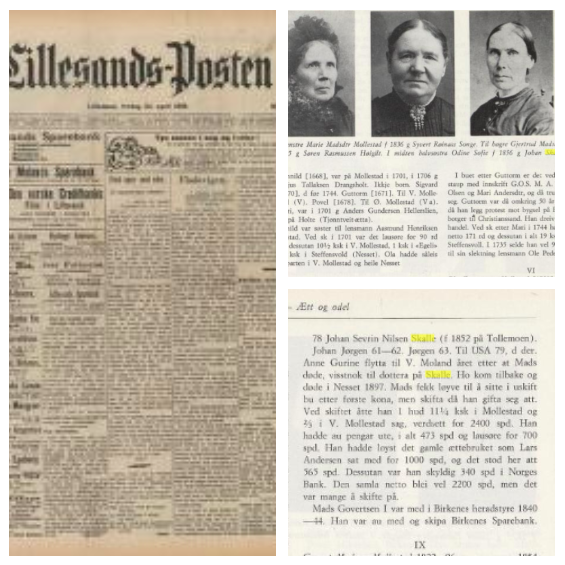
On the left: top image is a picture of Odine Sofie(pictured in the middle) and her two sisters (page 91) and the bottom is an article of Johan Severin Nilsen Skalle´s birth year 1852 and announcement of his voyage to The United States (page 92)
Why is there no more written history?T
When I researched my Family name on The Norwegian Genealogical Society I found nothing and I did not expect to find anything as well. Norway as one independent Kingdom did not exist until 1814. Norway is a young independent country and due to that, we have been influenced by both Danish and Swedish for centuries. We were in the Danish-Norwegian Union from 1537-1814 and the upper-class Norwegian spoke Danish and that is one of the reasons why we have two “languages” in the Norwegian language. The poor and the people who lived on the farms around the Norwegian countryside spoke in dialects and could not write. We have church book documentation and city documents for births and farm owners but no independent archive of the Norwegian families. The identity confusion and the lack of writing skills of family members might be a reason why there is not much family history written, but like Folklore, its shared from generation to generation. Even though its known that the last 4 generations in my father´s family could write, there was no culture in Norway of documenting family history
______________________________________________________________________________
Please note that some of these sources might only be accessed with a Norwegian IP address
newspaper: Lillesandposten (1938). Lillesandposten. [online] p.2. Available at: http://urn.nb.no/URN:NBN:no-nb_digavis_lillesandsposten_null_null_19380426_68_32_1 [Accessed 1 Jan. 2019].
book with pictures: Tveite, J. and Dolven, K. (1969). Birkenes 2: Ætt og odel. Høgfeldt A.S: Kristiansand S, pp.91, 92
info on Danish-Norwegian union: Weidling, T. and Njåstad, M. (2018). Norge under dansk styre – 1537-1814. In: Store Norske Leksikon. [online] Store Norske Leksikon. Available at: https://snl.no/Norge_under_dansk_styre_-_1537-1814 [Accessed 1 Jan. 2019].
Winter, J. and Sivan, E. (2000). War and Remembrance in the Twentieth Century. 1st ed. Cambridge University Press, p.144.
 A Father's Memory